Registre d’Échangistes de Cartes Postales Illustrées et de Timbres-Poste
An international network (1913–1938)
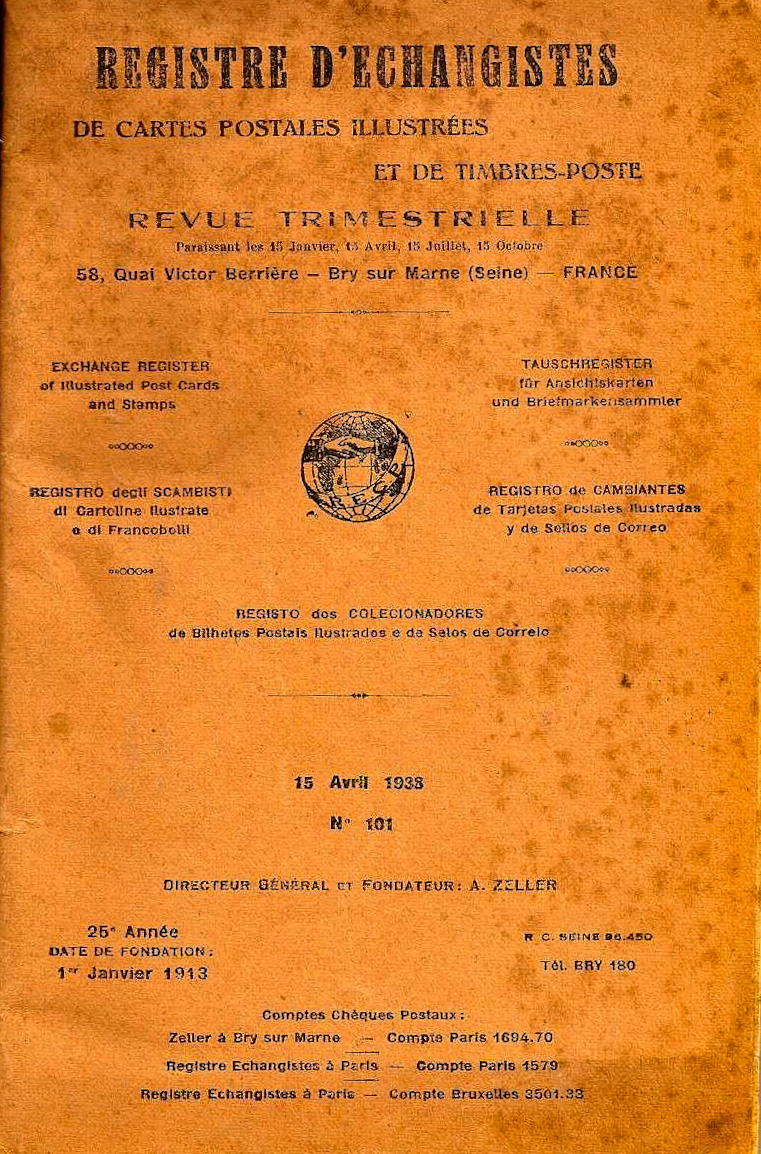
In 1913, A. Zeller launched an ambitious project from Bry-sur-Marne, a small suburb of Paris: an international register that would connect collectors of picture postcards and postage stamps. The Registre d’Échangistes de Cartes Postales Illustrées et de Timbres-Poste appeared as a quarterly publication on fixed dates: 15 January, 15 April, 15 July and 15 October.
What set the network apart was its radical multilingualism. The register presented itself simultaneously in six languages: French, English, German, Italian, Spanish and Portuguese. This was no symbolic gesture. The R.E.C.P. recognised that no language was neutral, and made it clear that it was an international platform where language barriers should be no obstacle.
August 1914: The silence
When the First World War began, everything stopped. Postal routes became military territory. German collectors could no longer trade with their French colleagues. Belgian members found themselves in occupied territory, cut off from the world. For four years the international collecting circuit was at a standstill.
Many R.E.C.P. members did not survive the war. Others lost their collections. Still others simply lost interest: who thinks of postcards when your city lies in ruins?
That A. Zeller managed to steer the register through this catastrophe is remarkable. The R.E.C.P. would ultimately exist for 25 years, from 1913 until at least 1938, when it published its 101st issue.
1919–1920: A cautious new start
Sometime in 1919, probably shortly after the Treaty of Versailles, the R.E.C.P. resumed publication. But this was no simple resumption. This was reinvention.
Europe had changed. Old empires no longer existed. New countries had come into being. Borders had been redrawn. And more importantly: could you rely on the post? Did you dare send something valuable to someone in a country you had just been at war with?
The R.E.C.P. network rebuilt itself slowly, cautiously. Correspondents wrote to each other with a mixture of courtesy and relief. It was not just politeness; it was recognition: we can talk to each other again.
How it worked
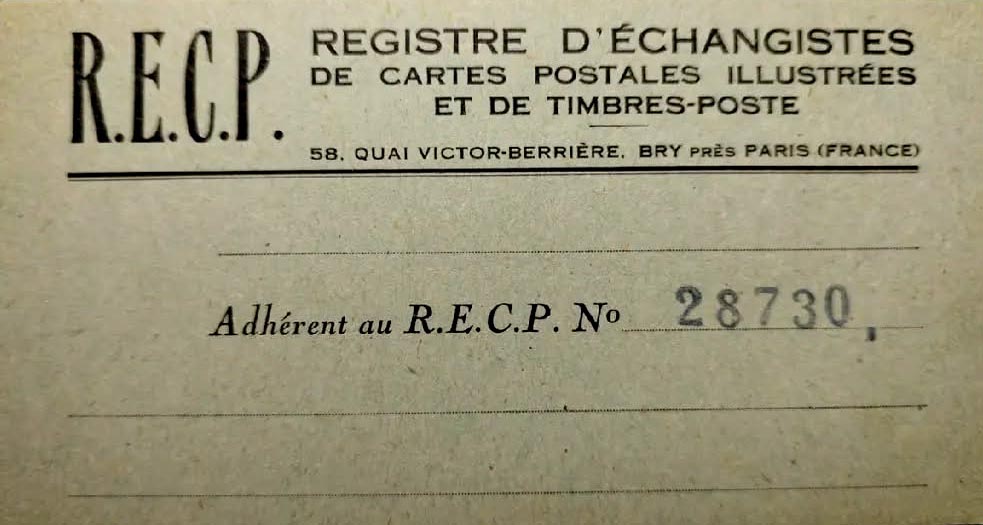
On joining, each member was given a unique R.E.C.P. number. This number served as an identity within the network and was often written on the back of cards. Through the quarterly magazine, members found each other’s addresses and registration numbers.
The system ran on reciprocity: if someone sent you a valuable card, you were expected to send back something of equal worth. This created a micro-economy without money, in which value was determined by rarity, condition and personal interest.
This required trust. And in 1920, after four years in which trust between European nations had completely imploded, every successful R.E.C.P. exchange was a small demonstration that civil cooperation was still possible.
Joseph and the R.E.C.P.
Joseph Verbrigghe became a member of the R.E.C.P. network around 1920 and was assigned number 7358. Between 1920 and 1922 he was particularly active: he received an average of 12 postcards a week from correspondents all over the world, including France, Luxembourg, Greece, Morocco, Japan and Canada.
For Joseph, who had just come through four years of German occupation, collecting postcards must have had something stabilising about it. Every new card that arrived was proof that the world was working again. That mail got through. That people kept their word. That international cooperation was possible, even on a small scale.
Local identity, global circulation
The R.E.C.P. operated on a remarkable principle: people stayed at home, but sent their surroundings out into the world. A correspondent in Luxembourg sent Luxembourg cards. Someone in Quebec sent Quebec cards. Someone in Thessaloniki sent views of the Greek port.
For Joseph, this meant that his collection became a collected world: Quebec without ever having been there, Thessaloniki through someone else’s lens, the Rhineland as a German publisher presented it. He did not travel. The world came to him, fragmented into stacks of postcards.
The network as utopia
There was something utopian about the R.E.C.P. network, especially in the 1920s. While politicians at Versailles divided Europe into winners and losers, R.E.C.P. members built a parallel world in which nationality mattered less than a shared passion.
A German member could trade cards with a French member. A Belgian member corresponded with someone from Luxembourg. It did not matter whether your country had won or lost the war. The only thing that counted was: do you have interesting cards?
This was not a conscious political statement. But without realising it, these collectors created an alternative geography: not of nations and borders, but of shared interests and aesthetic appreciation.
→ Discover the R.E.C.P.: International exchange in the shadow of war
→ Discover Joseph’s collection: The Global Story